
Friday, May 3, 2013

Miles, Bird, Armstrong Simulacrum Kits

The marketing orgy at Brilliant Corners Merch, Inc. marches on!
Inspired by the Thelonius Monk Round Midnight watch, we provided SimulacrumKits@ for Louis Armstrong and Charley Parker (see below). Once more, we have forged an unholy metaheuristic liaison, this time with a coven of disaffected Tampa Bay cheerleaders and created The Deluxe Miles Davis Simulacrum Kit. As with all our kits, it allows you to really "get next" this greatest of jazz improvisers. It includes:
1. Discarded Harmon mute stems (8)
2. Alimony check receipts (too many to count)
3. Harem pants (assorted colors)
4. Two roaches from Ferrari 275 ashtray (Davis ownership certified by Price Waterhouse)
5. 1944 Julliard Conservatory of Music freshman beanie
6. 1954 mash note from Bob Weinstock
7. Kind of Blue limited edition totebag
  
If the Davis Estate lawyers come  a-knockin', we're readin to start rockin'!
---------------------------------------------------------------------------------


Last summer, inspired by the alliance between Sony and the Miles Davis estate which offered a mouthpiece replica, t-shirts and other fascinating items, we created our own Louis Armstrong Simulacrum Kit. And, we couldn't keep 'em in stock!

Always eager to cater to the whims of the insatiable jazz consumer, we have forged a metaheuristic liaison with a clutch of Ukranian businessmen and created The Deluxe Charlie Parker Simulacrum Kit. It includes:
  1. A dental x-ray showing Bird's "upper partials."  
  2. A yardbird wing from 1941, preserved in formaldehyde and the wheel from the band bus that probably crushed it.
  3. A bottle of Gordon's gin salvaged from the wreckage of the old Birdland, with a letter of provenance from Willy's Liquor Store on 44th St.
  4. An early brochure from the Camarillo Chamber of Commerce
  5. A box of Dean Benedetti out-takes (so unlistenable that even Ross Russell wouldn't release them, but still...)
  6. One oboe reed with a imbedded Mitch Miller moustache hair.


And, for the first 20 buyers, we will throw in shards from the cymbal thrown by Jo Jones in the infamous jam session incident (verification pending).

So act now. Our 'operators' are standing by.
And, as we always say, "it's not re-animation, but it's pretty damn close."

------------------------------------------------------------------------
Some have castigated the recent alliance between Sony and the Miles Davis estate which offers "A mouthpiece replica of exactly the 'Gustat' Heim 2 model used by Davis especially created by Kanstul," t-shirts and other fascinating items. They even throw in 43 cd's. In fact, those corporate giants don't go nearly far enough in offering a package that can truly bring fans closer to their favorite artists. We have therefore forged a metaheuristic liaison with several Baltic-area businessmen and are delighted to offer the Deluxe Louis Armstrong Simulacrum Kit, composed of:
  1. A copy of the gun Armstrong shot off to get sent to the Colored Waif's Home for Boys.
  2. A facsimile of the original sisal belt Armstrong used to hold up his pants while delivering coal.
  3. A lump of coal.
  4. Two half-used packages of Swiss Kriss.
  5. A set of 10 designer "do-rags" created in honor of Satchmo's 100th anniversary.
  6. An "I Hate Bebop" pin, allegedly worn by Armstrong at an Elks Club meeting in Sept. 1952.
  7. A glassene envelope containing a half ounce of muggles that Armstrong forgot he even had.
Act today and we will throw in a re-engineered recording of Armstrong's solos with the King Oliver band, with the rest of that rickety group stripped off and replaced by the same excellent studio musicians Clint Eastwood used to replace Potter, Roach and Haig in the movie "Bird."  Act now. Our 'operators' are standing by. It's not re-animation, but it's pretty damn close.

Monday, April 22, 2013

A Salute to Musicians in the Community

As everyone knows, this was a dismal week here in Boston. The denouement could have been much worse, and we should be grateful for that, but the reverberations will continue for a long time. Bostonians are putting up a brave front, but something like this can't help but linger in our collective psyche. 

There are also ways to rebound from an event like this-lingering tete a tetes over tea or whiskey, bedroom escapades, bowling a couple of strings... Or my favorite: playing or listening to music in the street. 

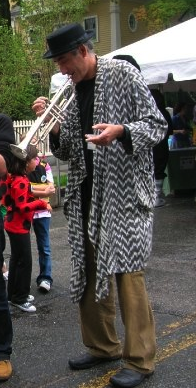
We had already planned as a band to play on Saturday and we walked onto what was an odd stage, in its way. People had been shut in their houses-under siege, really-for several days. There was still a skittish quality to people's attention. Traffic helicopters drew more than the usual casual glances. Unexpected sudden movements startled more. But, after we finished, we heard how much people had gotten from our music and from our rough, spontaneous choreography and I'm confident that we had helped replenish a vital force that had been drained out of our city.

So too does the music of musicians who go into the streets, the parks, the projects, the nursing homes, the schools-anywhere their communities can access what they have to share. Your work is incredibly important and I dedicate this post to you.

Thursday, April 11, 2013

Jazz and hip comedy. April 11 Radio show


"What, me? Worry. Jazz and hip comedy."  6-7 PM WZBC 90.3 FM, stream:  
Featuring Lenny Bruce, Nichols and May, Shelley Berman.

My apologies for not posting the audio file. It was recorded with distortion. Ugh. Here's the playlist:

The Duplex Mystery Jazz Hour (Specialty) with Steve Provizer 04/11/2013 06:00PM to 07:00PM

Clifford Brown “Tiny Capers”

Bob Newhart “Abe Lincoln” from The Button Down Mind Of

Jack Sheldon “Contour”

Lord Buckley “The Train” 

Lambert Hendricks and Ross “Charleston Alley” 

Mike Nichols And Elaine May “Telephone” from An Evening With Mike Nichols and Elaine May

Randy Weston “Lifetime” 


Lenny Bruce “How to Relax Your Colored Friends at Parties” 

Sonny Rollins "Rockabye Your Baby"

Shelley Berman “Woman Hanging From a Ledge” 


George Carlin “Modern Man”

Betty Carter “Frenesi”

Tuesday, April 9, 2013

That Damned Armstrong Quote


When asked 'what is jazz?' Louis Armstrong said; “If you have to ask, then you'll never know."

This thing shows up all the time-on websites, tweets, facebook. It shows how abysmal and embattled the state of jazz is that people have to self-aggrandize by declaring: “Look at me. I get it. I’m hip. If you don’t get it, hang your aesthetic tail between your legs and get lost.”

Armstrong probably said it. Why not? He said a lot of things. The point is, this quote is as unrepresentative of Pops as any quote you could possibly find. His life was about reaching out; about achieving an emotional connection with as many people as possible. He didn’t separate himself from the unhip. He drew them into his energy.

People, do you really have to use this music as some kind of emotional crutch, like teenagers arguing over their, like, favorite pop star? If you care that new people come into the fold, look at it this way: Non-jazz people are a lot more likely to be drawn to this music if they don't think the people who love it and support it are snotty jerks.

Friday, March 22, 2013

The Roots of Scat


Here is the file of my program of March 21, 2013 that explored the roots of scat singing which, according to no less an authority that Jelly Roll Morton, goes back to the turn of the century.


Here's the Playlist. I guarantee there are people on this playlist that you have never heard.

Saturday, March 16, 2013

Lost New Orleans


As Jazzfest approaches, time to trot out the fruits of my research and reveal some of the unknown, yet formative people and places in Crescent City Jazz history:

Musicians

One-Nostril Clyde
Toothpick Willie
Joseph 'Vaseline' Brunelle
Clyde 'Ofal' Pivnik
L'il Chicklets
Big Sluice
Leroy 'Creampie' Shavely
Melatonin Slim
Rufus 'Cutacle' Scaline
Buzz The Flea
Girdle and Griddlecakes Duffy(Siamese twins)
Oleander 'Sniffles' Zampa
Two-Crack Max Figgis
Langdon 'Crabcakes' Beaudoin

Joints

Sweetie Pie's Monodrome
Mamie's Mantis Hideaway
Queen Lillie's Nectar trap
Pookie's Natural Foods
Betty's Both-Ways Cabaret
Rita's Donuts and Crullers

Musical Organizations

Krispy Taylor's Trudgers
Juan San Juan and His Coffin Twirlers
Harry Ruby and the Minyon-aires
Clyde Baleen and the Super Sieve Six
The South Rampart St. Rhythm Manglers
Ollie's Watchfob Handlers
Louis The Greek's Menthol Stompers
Colonel Butt's Aftertaste Ragtime Orchestra
Ben Bichette's Trough Scrapers

Monday, March 4, 2013

Jazz Blogs; whither.


Some jazz blogs are straight ahead educational: "Download transcribed solos by Brownie, K.D. Miles, etc." God bless these people.

Most jazz blogs do the work of 'exposing' the music-"The Fearless Fosdyke Four will be at the Bluze and Brew Tavern/Festival/Restaurant this weekend. Don't miss it." Or: "You'll want to check out the FFF's latest CD release on the Gasoid label, available at Amazon/ Walmart/CD Baby/iTunes..." It works better if they post audio or video of the group in question.

Similar blogs, but with more critique, give you a blow by blow of concerts or cd's. These are almost always self-selecting for material the reviewer likes, so seldom is heard a discouraging word. This is often the home of The Top Ten List (see my other post on this menace).

Then, there are interview-oriented sites: "When last heard of, 33 years ago, Desmond LaBrea was on the road with the Jules Verne Aquanauts. We discovered him making baignets in Paduka and asked him why he left the world of riffing for the world of sifting..."

In the blogs above, there is often room for exploring jazz esoterica, i.e.: How many jazz groups have been named after lesser tributaries of the Snake River? I love that stuff.

Then, there are jazz blogs that are more 'meta.' They ask questions and may suggest solutions: "What's up with jazz? Where is the audience? Where's the money going?" "Let's do a Jazz IPO." It is in this arena that the rough-and-tumble lurking in the hearts of jazz people sometimes breaks out. I find the level of emotional engagement here seductive and enjoy this arena. This is where we get closest to experiencing personal agendas, but mostly, the emotion remains subtext, and infuses formal discussions on the redistribution of money, etc...

I have had a long musical life, marked with some pleasure, some pain and, at this point, a feeling of having read the same newspaper headlines over and over. I think this experience helps me sniff out magical thinking. Others see me as cynic. Both views are correct. We're all subject to the vagaries of age, temperament, career success, sex life-It's the human thing and, to the extent that the jazz blog world reflects this ungodly mess, I say it is better for it.

Some say the old battle between the Beboppers and the Moldy Figs was bad for jazz. Don't know. I think it was a reflection of the emotional importance that the music once had in many people's lives. Most homicide victims fall to the hand of someone they love, or once loved. By the same token, you're probably more likely to jump into swirling currents for the adored one. I'm not sure how many jazz bloggers I'd take the plunge for, but that's another story.


Thursday, February 7, 2013

Mute-a-bility (Pt.3) by Steve Provizer

Mute regrets, I've had a few. Like, Why did the great Roy Eldridge start using a harmon mute?

Roy's tone was a pile-driver; epic, a mover of mountains. It vibrated at the highest energies. Just listen to what I think is the ripest performance in the history of swing:


Friday, February 1, 2013

"The 7 Ages of Jazz-Kind" by Steve Provizer

Watching my daughter and I find that she's been co-opted by pop music and is currently off the jazz stages list, but thought I'd repost it for other parents who are trying to evaluate their offspring's development.

With apologies to Shakespeare.

I. The Infant:
Muling and puking. Parents play music at home and, too young to put up a struggle, he is exposed to Ellington or Basie, maybe Miles; Nancy Wilson, Sammy Davis Loves Broadway.

II. Whining Schoolboy:
Creeps unwillingly to his trumpet lesson. Is drafted into stage band at school and learns how to play "swing eight notes" in Sal Nistico arrangements.

III. The Lover:
Simultaneously experiences the first pangs of love gone sour and the aching balladry of Billie Holiday, Stan Getz and Ben Webster. Rejects all other musics as unworthy of his devotion.

IV. The Soldier
Full of strange oaths; i.e., II-V-I, arco, flat thirteen. Looks for respect in the jazz-session trenches and is willing even to face the Medusa Donna Lee in Dflat. Draws his sword against any who would denigrate his jazz gods. Soul-patched, like the pard Gillespie.

V. The Justice:
In fair round belly, with wise lese majeste, he accepts the endless cycles of "Kind Of Blue" on jazz radio. He learns to shrug off the hype surrounding the latest wunderkind and begins to find truth in the notes of the elders.

VI. Spectacled and Slippered:
The search for the right mouthpiece fades, as does his once robust tone.  The silence becomes more meaningful than the notes.

VII. Second Childhood. Taps his toe to Louis and then is heard no more.

Sunday, January 27, 2013

National Rock Association (NRA)


Recently, controversy has arisen over our efforts to introduce young people to the joys of rock throwing. Many of us in the NRA grew up in urban environments with an large indigenous supply of rocks and ample, safe targets that could be used by young people for healthy sport. It is our responsibility to pass on the joys of rock throwing to the next generation and, in the process, give our youth the chance to develop the kinds of physical, mental and ethical skills that will serve them so well later in life. 

We know that this healthy, deeply American process is being threatened, but we won't sit back and let that happen.

Instead, we have raised money to purchase abandoned factories and made the windows available for target practice. We have brought thousands of de-commissioned street lights to our compounds so that young people can exercise their minds and bodies in the same way that ancient Greeks would train to throw the javelin. 


We have designed a fabrication system that quickly renders a realistic 3-D target of the thrower's brothers and sisters. This adds verisimilitude to the process and our psychologists say it can help defuse sibling rivalries. 


There are ignorant people who don't know the difference between a hand rock, a hunting stone and an assault boulder and it is the misplaced moral judgements of these pathetic liberals that threatens to force rock throwing into a dark, uncontrolled underworld environment, where the building of satanic stone cairns and altars can flourish. 

Finally, we have begun stockpiling rocks as a necessary hedge against secret governmental plans to confiscate all rocks. We can and will fight this threat. The hulking monster that is our government daily threatens our precious independence, but we must take inspiration from the biblical story of Davis and Goliath; a story that shows us the continuing need to defend our right to bear rocks.

Tuesday, January 22, 2013

Jazz Reality Shows


Director of Research
We in the off-brand musical world are tired of being ignored by the moguls who feed the bottomless American appetite for reality TV shows. Ever proactive, if not quite sane, the Institute staff has taken the bit between our canines, and moved our preliminary reality programming foray into high gear; all strictly high-end stuff, of course:
Clearly a Put-Up Job

Who Wants to Marry a Jazz Musician? Premise: A jazz musician masquerades as a normal person. A dozen blindfolded beauties are given a list of questions on which the jazz bachelor has been coached. Every time he reverts to type and says "man" or "dig" a small electric shock is delivered, bringing him back within the bounds of acceptable behavior. The jazz bachelor and the lovely winner win a case of valve oil and a trip to the Jazz Hall of Fame.*


Real Housewives of the Real Book. Premise: We give you an inside look at the lives of girfriends and wives whose jazz musician partners host a never-ending series of jam sessions peopled by Craiglist zombies. Episode One: Greta Semiquaver wakes up in the middle of the night screaming. Several hours later, she's discovered in a corner drooling and mumbling "Blue Bossa-please no more-Blue Bossa" over and over.


Look Carefully For Contestant
Alaska Gig Hunters. Premise: Danger and adventure beckon as recent Berklee graduates are given a motorcycle battery to power their amps, instructions on handling a dog sled and sent to Alaska to play on the streets of Anchorage. Busking champs get to sleep indoors (albeit with naught but method books on which to rest their weary heads). 
No one's First Choice


Trading Bass Players. Premise: One band has a bass player that can keep good time, another one has a bass player that plays in tune, a third deals coke-well, you get the picture.


Bix vs. Bop
Battle of the Network Moldy Figs. Premise: Proponents of traditional jazz and bebop fanatics are locked in a room with a pile of 78's by Bird, Danny Barker, Monk, Mezzrow, Dexter, Condon, etc. After each side is played, contestants down shots of slivovitz and arm wrestle. At the end of each episode, Ed McMahon is summoned by ouija board and hands the winner an ectoplasmic check for $5000 a week for the rest of his life.


The Dreaded Turnaround Centrifuge

II-V Bootcamp. Premise: In order to learn what it really means to play chord changes, a group of fresh-faced recruits undergoes a series of physical and mental challenges. They must survive the nauseating Turnaround Ccntrifuge,  the terrifying jaws of the Lick Eliminator and withstand the bone-crunching pressures of the Koko Krusher. Drill sargeants are instructed to withhold cork grease, valve and slide oil as punishments for the inappropriate use of upper partials. Survivors are guaranteed work as middle school music teachers.
Harold Always Gets the Solos

My Big Friggin' Wedding Band. Premise: As larger wedding bands are replaced by smaller bands, which are replaced by DJ's, which are replaced by iPods, there are almost no wedding jobs left in Gotham City. Harold Goniff has cornered the market for the few remaining gigs. Now, bandleader Harold is besieged by marauding gangs of out of work musicians. Harold must expand the size of his band or face the wrath of the gangs. Episode One: see how many musicians can fit on the stage of a VFW hall and how 15 musicians try to divide up 6 free plates of chicken a la king.

*I know. There is no Jazz Hall of Fame


Jazz on Television: Threat or Menace?


Wednesday, January 16, 2013

"Alan Lomax," briefly reviewed

 Author John Szwed, who has also done bios of Miles Davis and Sun Ra, does an excellent job of delineating the work of Alan Lomax; work which altered the landscape of American music. Lomax doggedly sought out musicians in remote areas and prisons and brought their music to light-live, through radio, film and television. He was an early advocate of the need to provide a socio-political context for the music, which changed the approach of music archivists both in the US and abroadHe championed civil rights and tirelessly promoted the work of unknown musicians. 


Lomax was a driven, complicated man, who seems to have been as busy internally as he was externally. He was a risk-taker who was both inspired by and psychically somewhat intimidated by his father John. His sexual/romantic/family life was extremely complicated. He turned to and championed the talking cure. Despite his many successes and wide cultural acceptance, he remained broke his whole life. While elucidating an inner life is challenging, I would have liked Szwed to have put a little more meat on those particular bones. 

That said, this book does a fine job of showing us the power of Lomax's work. To some of us, more preoccupied with jazz, Alan and John Lomax are names we recognize and associate with folk music, but as this biography shows, Lomax pere et fils played a very important role in the preservation and presentation of several styles of American music-especially African-American music. A highly recommended read.

Monday, January 7, 2013

Sing Along WIth Diz


Brew reminds us that this year marks 20 years since the death of Dizzy Gillespie-one of the great souls of jazz. 

Some time ago, I wrote words for every note of Dizzy's amazing 1945 solo on I Can't Get Started. I invite you all to listen and to sing along, using my lyrics. If you don't know the solo, there's a lot of notes and it's a challenge. I've tried to notate it in a way that makes sense musically. Give it a shot and try as often as you like. If you get it down, record it and send it to me and I'll gleefully post your rendition. Tell your vocalist friends.

Long live Diz.


INTRO
Someone teach me to win;
Don’t know how to begin;
I’m getting desperate to capture your heart,
Won’t believe that I can’t make you love me.
All my dreams are of you I fear,
The promise of your love brings me through
Days on my own,
My fate so unknown, depends on you alone.
Though many days have passed I still can’t

CHORUS
Start to prove that I love you.
Doesn’t seem right or fair, that the
Things I do aren’t convincing you,
You’re all I need, don’t you believe me.
Everything I say and I do is just to
Show you and to convince you;
Endlessly I search for new

Hills to climb. Wars to win, worlds to conquer.
Flying around the world
And outposts I’ve charted,
Don’t mean a damn with you,
Why is it so,
My exploits leave you cold?
I’m doing it all, hoping you fall, breaking the wall, give me a call,
Telling me you’ll always care;
And that you’ll always be near.
You’re still su--

BRIDGE
--preme to me,
Lyrics I write of you, still scheming to
See you night and day.
I see your face in every flower and your
Eyes in stars that shine above.
Obsessed with trying to possess you and caress you,
Feel your touch so tender and loving, beautiful eyes looking into mine,
Hoping that you’ll trust that I’m willing to share all I own and that I love you with-

My body and soul, such a hard road.
Don’t ever believe I would deceive or mistreat you, run you around,
Only sounds I want to greet you with is
Joyful, tell you that my heart’s full.
Notes that are true and fine, listen to them,
Say that you’ll be mine.

CODA
Remember that it’s not what I say or I do,
But how I feel.
Please try to find the
Meaning inside all the foolish things I say and do.
Open up your heart,
Let me get started, with you.


Saturday, January 5, 2013

1950's Trumpets #4: Tony Fruscella

There's an ongoing discussion in jazz about the playing vectors represented by Louis Armstrong and Bix Beiderbecke and how these manifested through succeeding generations of trumpet players. How does a player use techniques like range, articulation and dynamics to favor melody and cool like Bix, or power and heat, like Louis?

The differences between schools are often exaggerated. After all, Pops knew melody and Bix did not lack fire, which makes placing most players squarely in one school or another difficult. Tony Fruscella, on the other hand, was clearly a child of Bix.
A brief recap shows that, in the Swing era, most players came from the Armstrong power vector-Roy Eldridge, Harry James, Charlie Shavers, Bunny Berigan, Rex Stewart... At the same time, though, there were players who, often choosing the cornet, stayed closer to Bix-Bobby Hackett, Wingy Manone, Billy Butterfield, Wild Bill Davison...

Bop trumpet players came more from power and technique-Dizzy Gillespie, Fats Navarro, Howard McGhee, Red Rodney, Sonny Berman. Miles Davis had technique, but edged more toward the Bix side of the ledger. The lineage of the "West Coast" players really comes from Bix and Miles. Of these, Chet Baker became the most well known.

Chet had very good chops, although he didn't have the top register that's associated with the Armstrong vector. However, his playing (more true in his earlier days) was strong and well articulated throughout his range.

If Bix, Miles and Baker diminished the importance of power over melody, Fruscella disregarded it almost completely.

Thursday, December 20, 2012

Jazz/Culture/Violence

Where does jazz fit in the post-Newtown discussion about violence and popular culture? 

While not really in the mix now, jazz has historically played the role that hip hop, some kinds of rock and video games now play. This short overview will look at mainstream perceptions of the relationship between jazz and "violence" and how that perception changed through time. 

Jazz grabbed a lot of pieces of American culture to create itself: field shouts, preaching, spirituals, minstrelsy, blues, ragtime, parlor music, brass band music. Further, most of those were, themselves, hybrid strains. 

Some of those influences, like spirituals, preaching and parlor music, self-identified as "genteel," or "uplifting." Some, like field shouts and hollers and blues, were labeled "slave music;" and were, by implication, "low." Minstrelsy and ragtime were associated with shakier morality-more urban, apt to indulge in "sophisticated" humor and often associated with houses of ill repute. Brass band music was energetic and its association with circuses(entertainment) reduced its moral tone. However, many of the trappings of performance-the military, the village green-were less suspect. Call it somewhere in between.

Each of these genres was also associated with the relative presence of, or lack of, violence. It's easy to see which was which.

By the turn of the 20th century, a music we now see as incipient jazz was being played by Buddy Bolden's group, Jelly Roll Morton and others. While it contained many musical influences, both "high" and"low," and was played at benign venues like parades and picnics, it was more closely associated with Storyville gut bucket joints, or the rough parts of cities like St. Louis and Memphis. Often described as wild and uncontrolled, the music was acquiring a specifically disreputable image.

Musicians in various cities were able to work both sides of the fence, playing improvisational music in joints and waltzes and quadrilles at balls and cotillions. With the unusual exception of James Reese Europe and the Clef Club in New York City, there was a racialist system which relegated darker-skinned musicians to gin joints, parades and lower-paying gigs, while whites or lighter-skinned creoles (in New Orleans) were able to work anywhere.

As the teens proceeded, there was more mixing among musicians and bands were expected to play many different kinds of "high" or "low-down" music, but by this point, jazz had provoked a serious moral backlash. Crusaders from many cultural niches helped to position it solidly as an anti-establishment music, associated with the demi-monde.

King Oliver and co. in Chicago
With the onset of Prohibition in 1919, jazz became anthemic for people flouting bourgeois norms. Bootleggers and other prospering members of the criminal class moved into the nightclub business and jazz was the music of choice. While merely a bystander, jazz became more specifically linked to violence, and moralistic, anti-jazz campaigns were common.

The backlash against Prohibition and its eventual demise in 1933 coincided with the rise of "swing" music. The cultural perception of jazz shifted and the music became less something to epater le bourgeoisie and more something you'd play on the jukebox in the malt shop. During WWII, the music "played its part," helped to sell war bonds and became even less associated with violence (any irony there?). 
The Connection
Post-war, jazz ran into more trouble because of its association with narcotics.  Mainstream perception, subject to the paranoia of McCarthy-ism and the patina of Eisenhower-era placidity, magnified the connection between jazz and a violent underworld. Still, it was not a monolithic public response. Rock and Roll records were being burned and benign public beatniks like Maynard G. Krebs were, like, acceptable to the masses.

By the 1960's, jazz moved toward a more centrist moral/cultural position. A wave of spiritualism, spearheaded by John Coltrane and wider adoption of the Muslim religion by jazz musicians had defused the jazz-violence connection. Also, rock was now clearly the music of the counter-culture.

In the following decades, the common perception of jazz, to the extent it was thought about it at all, changed little. Rock musicians remained the bad boys until they were supplanted by hip hop artists. Video games then joined them under the public microscope.

Even though jazz always had one (sometimes small) foot in elite social circles, it also talked about things that gentility-or hypocrisy-precluded as part of the cultural dialogue and which, at the least, had overtones of violence. So, while there are "political" dimensions to any outsider-minority-generated art, mainstream moral codes, at least in America, have always exerted more of a sanctioning influence over jazz than has The State. Even during the 1950's, when the narcotics-jazz connection was widely noted, the State Department sent jazz musicians around the world to try and help win the Cold War. 

The government has been too concerned with monitoring domestic political dissent and with its own overseas military campaigns, to pay much attention to the relationship of culture to violence on the home front. Even well-positioned crusaders like Tipper Gore have had a limited influence on government action. 

The debate has been dominated by the people with the loudest voice and the most money (the NRA, if you haven't figured it out), who have successfully reinforced archaic myths of rugged individualism and the right to the untrammeled arming of our populace.

Tuesday, December 18, 2012

The Truth About Mouthpieces (updated)

I recently posted about Booker Little and trumpet player/blogger Ian Carey commented: "interesting that he got that fat "1C" sound out of a tiny Al Cass 1-28!"

That's one facet of the mouthpiece mythology that I didn't get into in this original post: People believe they should strive to get to a bigger mouthpiece (1c-3c) so they can get to a "bigger sound." The truth is, it absolutely depends on the player. Enough great players with "fat" sounds have put the lie to it to make any young (or older) trumpet player think twice:

Clifford Brown's sound has always been renowned for its juiciness. What mouthpiece did he use? Bach 17C1 and 17C2, equivalent now to Bach 10 3/4 CW. Small.  Ditto Conte Condoli. Ditto Fats Navarro. You think of Red Allen's sound as small? Don't think so. He used a very small cup Zottola. Dizzy Gillespie: Al Cass 2-24 & 2-25-equivalent to a Bach 11.75. The list is long.

The neglect that I experienced around mouthpiece choice and which I believe continues in early brass education is sickening. Young players: You need to know how important mouthpieces are. I truly believe that players just starting out are given mouthpieces that are several sizes too big and trying to use a mouthpiece that's too big can really mess you up.

You can play almost any trumpet, unless it's a real piece of junk, but having the wrong mouthpiece can absolutely stunt your musical growth. When you pick up this beast of an axe, you need positive reinforcement to stick with it. The wrong mouthpiece can make it so much more difficult to play that it can erode morale and no doubt has led many to ditch the horn. On the other hand, finding the right size mouthpiece can be incredibly motivating and speed you on your way to great range and flexibility.

Friday, December 14, 2012

Artists Respond to Tragedy


From the biggest stars to those playing off nights in coffeehouses, musicians do have the power to effect change in this culture, by raising awareness and money for a cause. I call upon the members of the musical community to organize as quickly as possible to start the process.  The power of the NRA has been unassailable to this point and this must change. If you live in the Boston area, please let your presence and interest be known. 

I am confident that my own group, SLSAPS, will respond and possibly act as coordinators or, in any case, as a point of contact for either a single large effort or multiple efforts to raise money and support for gun control. 

The pain is deep, but we can do something. Let's do it.